
Last updated July 12, 2026
The Complete Guide to Garage Door in Yonkers
Most garage door guides could have been written about any city in America. They weren’t written for Yonkers. Here, a Tudor revival in Lawrence Park might hide a 1950s-era one-car garage with a 7-foot opening that no franchise truck stocks. A waterfront Colonial in Greystone faces salt-laden Hudson winds that pit steel tracks in half the time you’d see inland. And the split-level ranch in Crestwood? Its attached garage often runs on wiring installed when ½-horsepower openers were considered heavy-duty. We’ve spent two decades working on garage doors in Yonkers, and we’ve learned that the city’s architectural diversity — from 1920s brick to 2010s townhomes — creates failure patterns no generic guide predicts.
Quick Answer
A well-maintained garage door in Yonkers lasts 15–30 years depending on material, exposure, and neighborhood-specific factors like Hudson salt air or hillside drainage. Homeowners here face unique challenges: non-standard door sizes in pre-war housing, accelerated hardware corrosion near the waterfront, and opener strain from frequent cycling in dense neighborhoods. Regular inspection of springs, cables, weather seals, and opener force settings prevents most emergency failures.
Table of Contents
- How Yonkers Housing Eras Shape Garage Door Needs
- Yonkers Micro-Climates: Waterfront Salt vs. Inland Elevation
- Choosing Door Materials for Yonkers Conditions
- Garage Door Openers: Power, Placement, and Older Wiring
- The Most Common Garage Door Failures We See in Yonkers
- Non-Standard Openings: Why Custom Sizing Matters Here
- A Yonkers-Specific Maintenance Calendar
- Owner-Operated vs. Franchise Service in Yonkers
How Yonkers Housing Eras Shape Garage Door Needs
Yonkers isn’t architecturally monolithic, and neither are its garages. Understanding your home’s era helps predict what will fail and when.
Pre-War and Early 20th Century (1920s–1940s): Neighborhoods like Lawrence Park, Cedar Knolls, and parts of Northwest Yonkers feature detached garages — often brick or concrete block, sometimes converted from carriage houses. These garages commonly have 7-foot-wide openings, narrower than modern 8- or 9-foot standards. We’ve replaced dozens of doors in these structures where a previous installer forced a standard size, leaving gaps that invite drafts and compromise security. The original wood framing in these garages also shifts seasonally, requiring flexible track mounting rather than rigid bolt patterns.
Mid-Century Ranch and Split-Level (1950s–1970s): Crestwood, Colonial Heights, and similar areas feature attached garages with direct kitchen access. These doors cycle more frequently — often 4–6 times daily versus 1–2 for detached structures — accelerating spring fatigue. The attached configuration also means opener noise travels directly into living spaces, making belt-drive or wall-mounted jackshaft openers worth considering during replacement.
Post-1980s Construction and Townhomes: Newer developments near Ridge Hill and along Central Park Avenue typically have 8-foot insulated steel doors with modern torsion spring systems. Here, the issue isn’t sizing but builder-grade component selection — thin 24-gauge steel, basic openers, and minimal weatherstripping that degrades within 5–7 years in Yonkers’ freeze-thaw cycles.
Key neighborhood patterns we’ve observed:
- Northwest Yonkers (higher elevation, detached garages): Spring failures from temperature swings, rusted bottom fixtures from snow melt
- Southeast Yonkers (denser, attached garages): Opener logic board failures from electrical fluctuation, worn rollers from frequent cycling
- Waterfront zones (Greystone, Ludlow): Track corrosion, faded finishes, hardware pitting from salt-laden air
Yonkers Micro-Climates: Waterfront Salt vs. Inland Elevation
Yonkers spans roughly 200 feet of elevation change from the Hudson River to the city’s northern ridge, and that geography creates distinct garage door stress patterns.
The Hudson Waterfront Effect: Homes within a half-mile of the river — particularly in Greystone, Ludlow Park, and parts of Getty Square — experience accelerated metal corrosion. Salt aerosol from the river penetrates garage spaces even with doors closed, attacking galvanized steel components from the inside out. We’ve replaced track systems in waterfront homes after 8 years that would last 15+ inland. For these properties, we specify stainless steel or heavy-galvanized hardware upgrades, and we recommend annual lubrication with silicone-based products rather than standard lithium grease, which washes away faster in humid conditions.
Inland Freeze-Thaw Cycling: At higher elevations in Northwest Yonkers and around Sprain Ridge, winter temperatures drop 5–10 degrees below waterfront readings. This intensifies contraction stress on metal components and makes weather seal brittleness a bigger factor. We’ve seen rubber bottom seals crack completely through after single-digit nights, leaving gaps that channel meltwater directly onto the garage floor — a particular problem for homes with finished basement space below.
Precipitation Patterns: Yonkers averages 47 inches of annual precipitation, with winter storms frequently mixing snow, sleet, and freezing rain. The freeze-thaw cycle is hard on door panels: water infiltrates minor finish breaches, expands when frozen, and creates propagation paths for larger failures. On wood doors common in historic districts, this manifests as delamination at panel joints. On steel doors, it appears as bubbling under paint or factory finish — cosmetic at first, but eventually compromising the substrate.
Choosing Door Materials for Yonkers Conditions
Material selection in Yonkers requires balancing aesthetics, durability, and micro-climate exposure. Here’s how the common options perform here:
Steel (Most Common): Modern steel doors — particularly Clopay and Amarr models we install regularly — offer the best durability-to-cost ratio for most Yonkers homes. Key specification: 24-gauge minimum for single-layer doors, or insulated sandwich construction (typically 1⅜” to 2″ thick) for attached garages where thermal performance matters. In waterfront zones, we specify galvanized or Galvalume coatings and upgrade to nylon-coated rollers to reduce track contact corrosion. Steel’s weakness here is cosmetic: dents from basketballs and recycling bins show readily, and salt air can pit lower panels where road splash accumulates.
Wood and Wood Composite: Required by some historic district guidelines and preferred by many pre-war homeowners for aesthetic continuity. Solid wood offers unmatched appearance but demands diligent maintenance — annual refinishing in exposed locations, prompt seal replacement, and vigilance for moisture intrusion at panel joints. We’ve restored wood doors in Lawrence Park that were structurally sound after 40 years because owners maintained them; we’ve replaced others at 12 years because deferred maintenance allowed rot to progress past recovery. Composite materials (fiberglass-skinned or vinyl-wrapped) offer lower maintenance with moderate aesthetic compromise.
Aluminum and Glass: Gaining popularity in contemporary renovations, particularly for street-facing garages in denser neighborhoods. Aluminum resists corrosion better than steel in waterfront conditions, though it’s softer and more dent-prone. Full-view glass panels require tempered glass per New York State code and need regular track cleaning — salt residue binds to rollers and accelerates wear.
Insulation Value: For attached garages, we typically recommend R-value of 10–12 minimum (polyurethane foam-injected construction). This matters in Yonkers: a garage sharing a wall with living space acts as a thermal buffer, and an uninsulated door creates measurable heat loss that extends HVAC runtime.
Garage Door Openers: Power, Placement, and Older Wiring
Opener selection in Yonkers involves more than horsepower rating — electrical infrastructure, ceiling height, and usage patterns all matter.
Power Sizing: Standard 7-foot steel doors up to 16 feet wide function adequately with ½-horsepower openers. However, we frequently upgrade Yonkers homeowners to ¾-horsepower units for three reasons: heavier insulated doors, aging springs that increase lift load, and the safety margin that prevents opener strain as components wear. For solid wood doors or one-piece tilt-up configurations still found in pre-war garages, ¾ horsepower is minimum.
Drive Type Selection:
- Chain drive: Most economical, durable, but noisy. Suitable for detached garages where noise doesn’t transmit to living space.
- Belt drive: Quieter operation via reinforced rubber belt. Our recommendation for attached garages in Crestwood, Colonial Heights, and similar neighborhoods where bedrooms sit above or adjacent to garage space. Genie and LiftMaster both offer reliable belt-drive models we service regularly.
- Wall-mounted (jackshaft): Mounts beside the door rather than overhead, freeing ceiling space for storage. Requires torsion spring system and minimum 8 inches of side room. Excellent for low-ceiling garages common in 1950s–60s construction, but higher cost limits adoption.
Electrical Infrastructure Reality: Yonkers’ older housing stock often has garage circuits shared with kitchen appliances, outdoor outlets, or basement lighting — configurations that predate modern electrical codes. Opener installation in these homes sometimes requires dedicated circuit installation, particularly for ¾-horsepower units with higher startup current draw. We’ve encountered homes where a garage door opener trips breakers when a toaster or microwave operates simultaneously. This isn’t an opener defect — it’s an electrical design issue that needs qualified electrician involvement.
Smart Connectivity: Modern openers with WiFi integration (LiftMaster myQ, Genie Aladdin Connect) allow remote monitoring and operation. In Yonkers’ denser neighborhoods where package theft concerns exist, the ability to open the door for delivery and verify closure remotely has practical security value.
The Most Common Garage Door Failures We See in Yonkers
After 20 years and thousands of service calls, these failure patterns dominate our Yonkers workload:
1. Torsion Spring Fracture
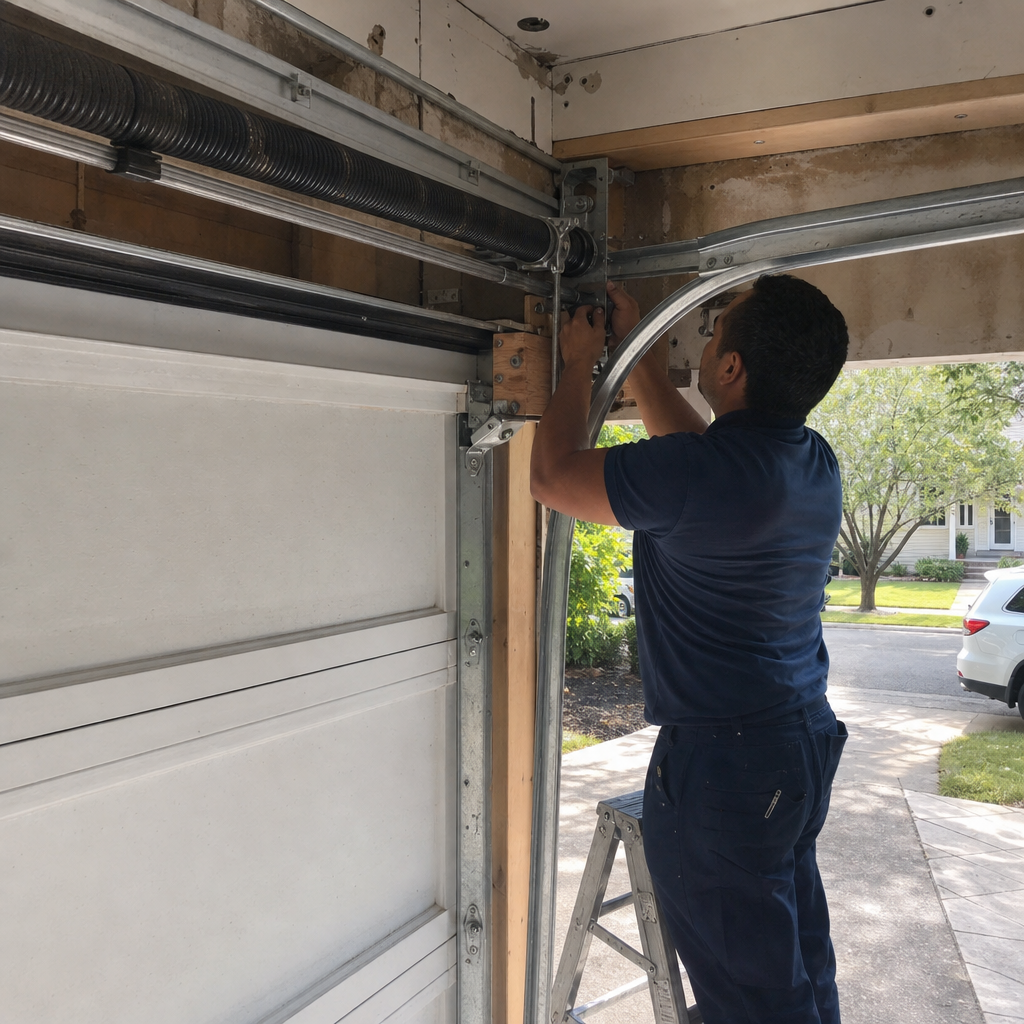
The heavy-duty spring above your door does the actual lifting; the opener merely guides. Standard torsion springs are rated for 10,000 cycles (roughly 7 years at 4 cycles daily). In Yonkers, we see accelerated fatigue from two factors: temperature cycling that stresses metal crystalline structure, and doors that settle out of alignment, causing uneven spring loading. When a spring breaks, you’ll hear a loud bang — sometimes mistaken for a car backfire — and the door becomes deadweight. Safety note: Torsion springs store lethal tension. Never attempt DIY replacement. The winding process requires specialized tools and training; injuries from spring release are among the most severe we encounter in residential repair.
2. Cable Fraying or Detachment
Cables transfer spring force to the door’s lift mechanism. They fray from abrasion against misaligned drums or corrode from moisture exposure — particularly common in garages with drainage issues or direct snowmelt contact. A frayed cable can snap under load, causing the door to drop unevenly or jam completely.
3. Opener Logic Board Failure
Modern openers rely on circuit boards vulnerable to electrical surge and age-related capacitor degradation. Yonkers’ older electrical infrastructure, with frequent neutral bonding issues in pre-1970s wiring, creates conditions where small voltage fluctuations damage sensitive electronics. We keep replacement boards for LiftMaster, Chamberlain, Genie, and Craftsman units in our service vehicle — most logic board replacements complete in under an hour.
4. Track Misalignment and Roller Wear
Vertical tracks must remain parallel within ¼-inch over the door height. Settlement of garage slabs — common in Yonkers’ clay-heavy soils, particularly on hillside properties — gradually shifts track mounting points. Rollers then bind, creating noise and accelerating wear. Nylon rollers degrade faster in temperature extremes; steel rollers last longer but are noisier and corrode in waterfront exposure.
5. Weather Seal Deterioration
The rubber or vinyl seal at the door bottom and between panels hardens and cracks over 3–5 years of Yonkers weather exposure. Failed seals admit water, debris, and rodents; they also eliminate thermal buffering for attached garages. Replacement is straightforward but often deferred until visible gaps appear.
Non-Standard Openings: Why Custom Sizing Matters Here
This is where Yonkers diverges sharply from suburban markets with uniform new construction.
We’ve measured garage door openings in pre-war Yonkers homes as narrow as 6 feet 8 inches — dimensions that haven’t been standard since the 1940s. National franchise operations typically stock 8×7, 9×7, 16×7, and 16×8 doors on their trucks. When they encounter a 7-foot-wide opening, the common response is “we’ll need to order that” — adding 2–4 weeks to a job that a prepared local service completes same-day.
Bluepeak maintains relationships with Clopay and Amarr for rapid custom sizing, and our shop can modify track hardware for non-standard widths. This matters for:
- Pre-war detached garages with original masonry openings
- Carriage-house conversions where the original door height exceeds modern standards
- Accessory structures (separate garage apartments, workshop buildings) with non-standard proportions
- Historic district properties where exterior modifications face review board scrutiny
Custom sizing adds 10–20% to material cost but eliminates the compromise of poorly fitted standard doors — gaps that admit weather, reduce security, and accelerate hardware wear from improper load distribution.
A Yonkers-Specific Maintenance Calendar
Preventive maintenance extends door life and prevents emergency calls. This schedule reflects Yonkers’ specific climate stressors:
Monthly (Year-Round):
- Visual inspection of springs, cables, and rollers for fraying, rust, or deformation
- Test door balance: disconnect opener and lift manually — the door should stay at mid-height without drifting
- Listen for grinding, squealing, or irregular noise during operation
- Verify safety reverse function: place a 2×4 flat on the floor; the door should reverse on contact
Quarterly:
- Lubricate rollers, hinges, and bearing plates with silicone-based lubricant (waterfront homes) or lithium grease (inland)
- Inspect weather seal for cracking or compression set
- Clear track interior of debris and accumulated road salt
- Tighten visible hardware — vibration loosens brackets and fasteners over time
Bi-Annually (Spring and Fall):
- Comprehensive hardware inspection, including spring tension measurement
- Opener force and limit adjustment verification
- Panel finish inspection for breach points where moisture can infiltrate
- Drainage check: ensure garage slab slopes away from door threshold, and downspouts don’t discharge toward garage
Annual: Professional inspection by a qualified technician. Spring tension measurement requires specialized tools; force gauge verification of opener safety systems ensures code compliance. In our experience, annual professional service catches 80% of impending failures before they become emergencies.
Owner-Operated vs. Franchise Service in Yonkers
The garage door service market in Yonkers includes national franchise networks, general handyman operations, and owner-operated specialists. The differences matter more than most homeowners realize.
Accountability Structure: When you call a franchise, a dispatcher takes the call, a subcontractor receives the work order, and the technician who arrives may have started with the company weeks ago. If something goes wrong, responsibility diffuses across that chain. At Bluepeak, Jeffrey Morgan answers the call and often makes the repair — the same person who owns the business, maintains its reputation, and has 868 reviews reflecting 20 years of individual accountability. There’s no gap between promise and performance.
Parts Availability: Franchise technicians carry standard inventory for common door sizes. Non-standard Yonkers openings, older Wayne Dalton or Raynor hardware, or discontinued Genie opener models often trigger “we’ll have to order that” delays. An owner-operator with two decades in the trade has encountered these configurations before and stocks accordingly — or knows same-day sourcing that newcomers don’t.
Diagnostic Depth: Garage door problems have root causes. A binding door might indicate track misalignment, spring fatigue, or foundation settlement. Technicians incentivized by call volume tend to treat symptoms; owner-operators with long-term reputation investment diagnose causes. We’ve saved Yonkers homeowners repeated service calls by identifying underlying issues that symptom-focused repairs missed.
Response for Urgent Situations: When your door won’t open at 7 a.m. and your vehicle is trapped inside, callback speed and dispatch flexibility matter. Owner-operated services typically route calls directly to the decision-maker, not through a call center with escalation protocols. Emergency garage door service is built into our business structure — not an afterthought added to capture search traffic.
We’ve also prepared related guides for neighboring areas: Garage Door Repair in Bronxville, Garage Door Installation in Bronxville, and Garage Door Opener in Bronxville.
Common Mistakes to Avoid
- Ignoring spring age: Torsion springs have finite cycle life. Waiting for visible failure risks a trapped vehicle or sudden collapse. In Yonkers’ temperature-cycling environment, plan replacement at 8–10 years regardless of apparent condition.
- Installing standard doors in non-standard openings: The gap left by an undersized door admits weather, reduces security, and strains hardware. Measure twice — or better, have a technician verify rough opening dimensions before ordering.
- Neglecting track cleaning after winter: Road salt accumulates in tracks through March and April, accelerating roller and bearing corrosion. A quarterly wipe-down with damp cloth prevents cumulative damage.
- DIY spring or cable work: The tension in a standard torsion spring can cause severe injury or death if released improperly. This isn’t hyperbole — we’ve seen the aftermath. These components require trained handling.
- Matching new opener to old wiring without inspection: Yonkers’ older homes often have garage circuits inadequate for modern opener current draw. A brief electrician consultation prevents repeated breaker trips and potential fire hazards.
- Choosing aesthetics over material suitability: That beautiful wood door needs annual maintenance commitment. If you’re not prepared, specify steel with wood-grain finish or composite construction for Yonkers exposure.
- Deferring weather seal replacement: A $30 seal left too long allows water infiltration that damages door bottom, promotes floor spalling, and invites rodent entry. Replace at first visible cracking.
When to Call a Professional
Call for service when you observe: loud popping or grinding during operation, visible spring gaps or cable fraying, door drift when manually tested, opener strain (motor labors or reverses unexpectedly), or any sudden change in door behavior. These symptoms indicate conditions that worsen with continued use and may create safety hazards.
For installation or replacement, professional measurement ensures proper sizing, especially in Yonkers’ older housing with non-standard openings. Opener selection also benefits from on-site electrical assessment — a step that prevents compatibility problems after purchase.
Bluepeak Garage Door Repair Yonkers offers free estimates in Yonkers — call (833) 892-8769. Jeffrey Morgan handles consultations directly, and we stock components for same-day repair on most major brands including Clopay, Amarr, Wayne Dalton, and Genie systems.
Frequently Asked Questions
Most residential repairs in Yonkers range from $150 for roller or cable replacement to $350–$500 for torsion spring replacement, with full door replacement starting around $1,200 for standard steel insulated models. Custom sizing, wood construction, or upgraded hardware increases cost proportionally. We provide exact quotes after on-site inspection — call (833) 892-8769 for a free estimate with no obligation.
A quality steel door lasts 20–30 years with maintenance in Yonkers, though waterfront exposure may reduce finish life to 10–15 years. Wood doors last indefinitely structurally but require 15–20-year panel replacement cycles if maintained; unmaintained wood fails in 8–12 years. Opener lifespan typically runs 10–15 years depending on cycle frequency and electrical conditions.
Yes — for most common failures including spring fracture, cable detachment, opener malfunction, and track misalignment, we complete same-day repair when called during business hours. We stock springs, cables, rollers, and logic boards for LiftMaster, Chamberlain, Genie, Craftsman, and other major brands. Emergency garage door service is available for situations where the door is inoperable or poses security risk.
Repair is more economical when the door structure is sound and failure is isolated to springs, cables, opener, or hardware — typically under $600 total. Replacement becomes cost-effective when panels are dented or corroded, the door is uninsulated in an attached garage, or cumulative repair costs exceed 50% of replacement price. We assess honestly; there’s no advantage to us in selling unnecessary replacement.
Noise sources vary: grinding often indicates worn rollers or dry bearings; squealing suggests hinge or spring binding; rattling points to loose hardware; and opener strain noise means the door is out of balance or the opener is undersized. In Yonkers’ attached garages, noise transmits directly to living space, making belt-drive opener upgrades and nylon roller replacement particularly valuable improvements.
Permit requirements depend on scope: direct door replacement in existing opening typically doesn’t require permit, but structural modification to opening size, electrical work for new circuits, or work in designated historic districts may trigger Yonkers Building Department review. We advise homeowners on permit status during consultation and coordinate documentation when required.
The Bottom Line
Yonkers garage doors face distinct challenges — salt air corrosion near the Hudson, freeze-thaw stress at higher elevations, non-standard openings in pre-war housing, and electrical infrastructure that predates modern opener requirements. Generic advice fails here because the city’s architectural diversity creates equally diverse failure patterns. Material selection, maintenance timing, and service provider choice should reflect your specific neighborhood conditions and home era. The owner who answers your call and understands these local factors will deliver more durable results than any templated approach.
Questions about your specific door or situation? Call Bluepeak Garage Door Repair Yonkers at (833) 892-8769 for a free estimate. Jeffrey Morgan handles consultations directly — the same person who owns the business and stands behind every repair.
Written by Jeffrey Morgan, Owner & Lead Technician at Bluepeak Garage Door Repair Yonkers, serving Yonkers since 2006.