
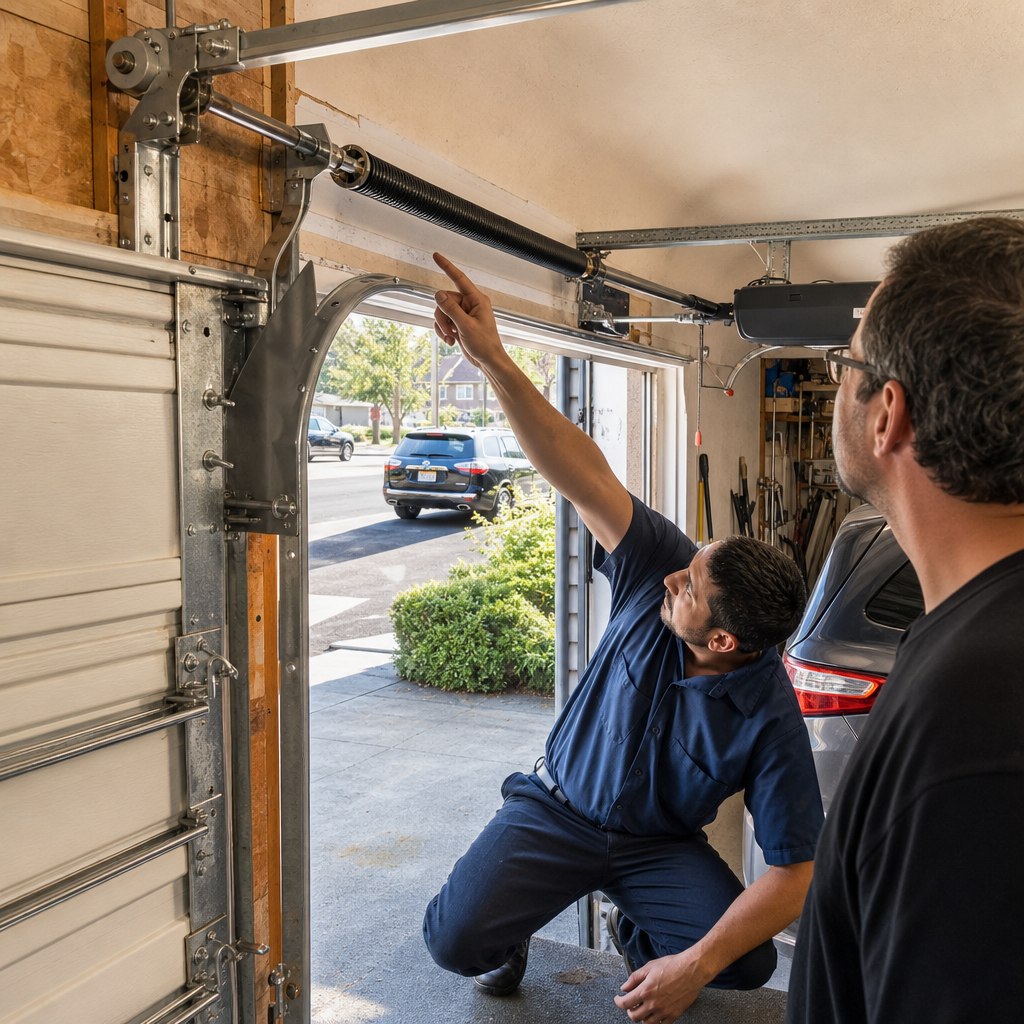
Why Your Garage Door Won’t Close in Yonkers — And the One Winter Cause Most Homeowners Miss
A garage door that won’t close is usually reversing on contact with an obstruction you can’t see, not suffering a broken opener. In Yonkers, the single most overlooked cause is ice bonding the bottom seal to a sloped concrete apron — the opener’s safety system reverses the door three inches from the floor, but the homeowner sees “won’t close” and assumes sensor or motor failure. Call Bluepeak Garage Door Repair Yonkers at (833) 892-8769 for same-day diagnosis; most fixes run $150–$600.
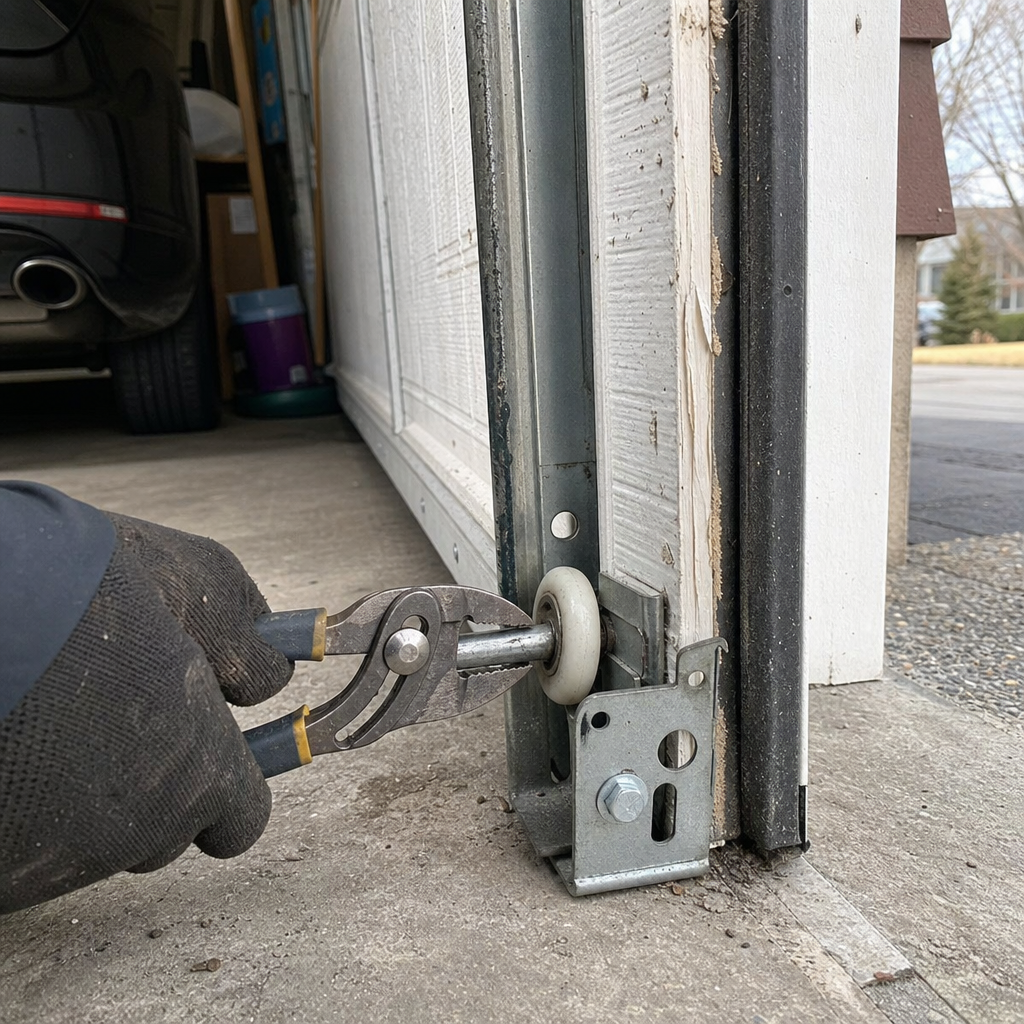
The Ice Ridge Nobody Checks For
Nine times out of ten when we get a “Why Does my Garage Door Reverse? (Yonkers, NY)” call from Park Hill or Nodine Hill in January, the door is closing perfectly — it’s just reversing three inches from the floor because the bottom seal is touching an ice ridge the homeowner hasn’t spotted yet.
Here’s how it develops. Yonkers rises sharply from the Hudson River, and garages in southwest neighborhoods sit on hillside lots with driveways that pitch toward the door. Meltwater from daytime thawing runs down that slope, pools at the apron, and refreezes overnight into a hard ridge. When you hit the remote in the morning, the door travels down normally until the rubber seal meets that ice. The opener’s down-force safety limit — required by federal law since 1993 — detects the resistance and reverses the door. To you, it looks like the door “won’t close.” To the opener, it’s doing exactly what it’s designed to do.
We saw this twice last week alone. One homeowner in Nodine Hill had already unplugged his LiftMaster and was shopping for a replacement online before he called us. Jeffrey Morgan, our Owner and Lead Technician, walked him through a 30-second flashlight check — ice visible on the concrete, frost on the seal — and the fix was a kettle of warm water and patience, not a $400 opener bill. If I can’t explain what’s wrong in plain English, I haven’t figured it out yet.
The Hudson River Valley’s freeze-thaw band makes this pattern worse here than in towns just 10–15 miles inland. Temperatures in Yonkers oscillate around 32°F rather than staying deeply cold, so you get daily melt-and-refreeze cycles that build ice ridges repeatedly through February. River-proximity humidity also accelerates rust on springs and cables, but that’s a separate issue — the immediate “won’t close” symptom is usually that ice bond.
Self-Diagnosis Before You Call
Before assuming sensors, motor, or worse, do this:
- Go outside with a flashlight and examine the concrete within two inches of where the door stops
- Look for ice, frost, or a visible ridge along the door’s path
- Check if the bottom seal itself is stiff or frozen to the concrete
- If ice is present, pour warm (not boiling) water along the threshold and wait 10 minutes
- Try the door again — if it closes fully, you’ve found your cause
If there’s no ice and the door still reverses, the cause is elsewhere. Don’t force the door repeatedly — stripped opener drive gears from forced operation are a $250–$550 repair we see every February after ice events.
Three Other Real Causes in Yonkers Homes
When ice isn’t the culprit, we diagnose in this priority order based on twenty years of calls in Yonkers:
1. Frost-Heaved Sensor Misalignment
The photo-eye sensors sit 4–6 inches off the floor on brackets that shift as concrete expands and contracts through freeze-thaw cycles. A bracket moved even 1/8 inch breaks the invisible beam between transmitter and receiver, triggering immediate reversal. In Yonkers’s 1910s–1940s masonry garages, that concrete movement is more pronounced than in modern slab construction.
On LiftMaster and Chamberlain openers, a steady red or orange light on one sensor and blinking on the other means misalignment — not failure. On Genie systems, three blinks of the wall-button LED typically indicates the same. Most homeowners call before checking the obvious, and a 30-second bracket adjustment costs nothing. We carry replacement brackets for all major brands because frost heave here makes this a recurring seasonal issue.
2. Down-Limit Drift From Temperature Swings
The opener’s internal travel limits — the electronic stops that tell the motor “the door is fully closed” — can drift in garages that swing from 25°F overnight to 45°F by afternoon. The limit switch thinks the floor is higher than it actually is, so the door stops short and appears “stuck open.” This is particularly common on older Genie screw-drive units and pre-2018 Chamberlain chain drives, both well-represented in Yonkers’s older housing stock.
Recalibrating limits takes 5–10 minutes with the manufacturer’s procedure; we don’t charge for this if it’s the sole issue on a service call. Attempting this without knowing your opener’s specific button sequence can erase all travel settings, so we recommend having it done professionally unless you’re certain of your model’s procedure.
3. Bent or Obstructed Track on Masonry Garages
Yonkers’s dense stock of attached brick homes from the 1910s–1940s contains narrow single-car garages with low headroom clearances — often under 7½ feet. The horizontal track sections in these garages run shorter and steeper than modern standards, putting more load on the track itself. A cold snap that contracts metal slightly can reveal existing track fatigue: a 1/4-inch bend or a roller jumping its rail causes the opener to detect irregular resistance and reverse.
Track realignment runs $120–$240 in our Yonkers market. Severe bends in the original track of a 1920s garage sometimes require custom-bent replacement sections, since standard 2-inch or 3-inch track won’t match the original geometry. We’ve fabricated these on-site for homes near Sprain Ridge Park where original construction details don’t match any catalog part.
What “Door Won’t Close” Repair Costs in Yonkers
Most “won’t close” calls resolve without major parts. Here’s what we typically see:
| Issue | Typical Range |
|---|---|
| Sensor realignment / bracket adjustment | $120–$180 |
| Opener limit recalibration | $120–$180 |
| Track realignment (minor) | $120–$240 |
| Track section replacement | $180–$340 |
| Opener drive gear repair | $180–$320 |
| Full opener replacement | $250–$550 |
| Bottom seal replacement (ice-damaged) | $130–$250 |
Emergency Garage Door Repair in Yonkers, NY is a core offering at Bluepeak, not an afterthought — built into the business for customers whose door fails at 11 PM in January when the garage connects directly to a living space through an entry door. The owner answers the call and often makes the repair.
Common Local Scenarios We See in Yonkers
The 6 a.m. commuter in Park Hill. Door reverses three times, you give up and leave it open, your car sits exposed all day. By evening, the ice ridge has melted and the door works fine — until tomorrow morning. We install Garage Door Repair threshold seals with better cold-weather flexibility and adjust down-force settings for sloped-apron conditions.
The three-family homeowner near Getty Square. Tenant calls at 10 PM: “garage door won’t close, I can’t lock the building.” The entry door from garage to basement means this is a security issue, not a convenience. Jeffrey has responded to these calls personally at midnight because the garage is the building’s primary access point.
The inherited Craftsman opener in a 1930s colonial. Unit still works but lacks modern force-sensitivity adjustment. A minor track irregularity that a current LiftMaster would compensate for causes total reversal. We can often recalibrate within the unit’s limited range, or quote a modern replacement with battery backup — increasingly relevant given Westchester’s winter power outage frequency.
The forced-door disaster. Every February in Nodine Hill, someone tries to override the reversal by holding the wall button (which bypasses the photo-eye but not the force limit) or by pulling the emergency release and lowering manually onto ice. Result: stripped drive gear, damaged bottom seal, or worse — a door that crashes down when the ice finally breaks. The $150 sensor call becomes a $600 opener replacement. Don’t force it.
When to Call a Professional
We’re not going to walk you through adjusting torsion springs or releasing cable tension — those components store lethal energy, and a wrong move causes serious injury. If your “won’t close” diagnosis points to anything beyond ice removal or sensor alignment, the safe call is a trained technician.
Specifically in Yonkers, call us when:
- The door reverses with no visible obstruction after ice check
- Sensor lights show abnormal patterns you can’t interpret
- The door hangs crooked in its tracks or makes grinding noise
- Manual operation (pull the red emergency release) feels heavy or uneven
- You’re dealing with a pre-2000 opener whose manual is long lost
Two decades of garage doors — not two years and a van. Whatever brand is on your door, we know it: LiftMaster, Chamberlain, Genie, Clopay, Amarr, Wayne Dalton, Craftsman, Raynor. Nearly 900 homeowners reviewed us at 4.8 stars because we diagnose honestly and fix what needs fixing.
FAQs
Most repairs run $150–$600 depending on whether the issue is alignment, limit calibration, or component replacement. A simple sensor realignment or ice-related threshold fix typically falls at the lower end; opener drive gear or track replacement pushes toward the higher end. Call (833) 892-8769 for an exact quote — estimates are free.
Yes — emergency garage door service is built into our operation, not added as an upsell. When your door won’t close at 7 a.m. and you’re trying to get to work, that’s exactly when we’re built to help. Jeffrey Morgan, our Owner and Lead Technician, still handles early and urgent calls personally.
Repair is usually cheaper if the unit is under 12 years old and the issue is limits, sensors, or drive gear — typically $120–$320. Replacement makes sense when the opener lacks safety features required since 1993, has repeated failures, or would need obsolete parts. We’ll tell you straight if repair is throwing good money after bad.
Temperature-related expansion and contraction of metal tracks, concrete, and opener electronics change the system’s tolerances. In Yonkers specifically, the freeze-thaw band around 32°F creates ice bonding at sloped aprons and frost heave on sensor brackets — both absent in warmer months. Seasonal “won’t close” calls spike here every January through March.
Get Your Door Closing Again
If you’d rather have it looked at, Bluepeak Garage Door Repair Yonkers offers Best Garage Door Repair in Yonkers, NY with a no-pressure assessment — call (833) 892-8769. Jeffrey Morgan will answer, diagnose what you’re dealing with, and get it handled without the runaround.
Written by Jeffrey Morgan, Owner & Lead Technician at Bluepeak Garage Door Repair Yonkers, serving Yonkers, NY.