
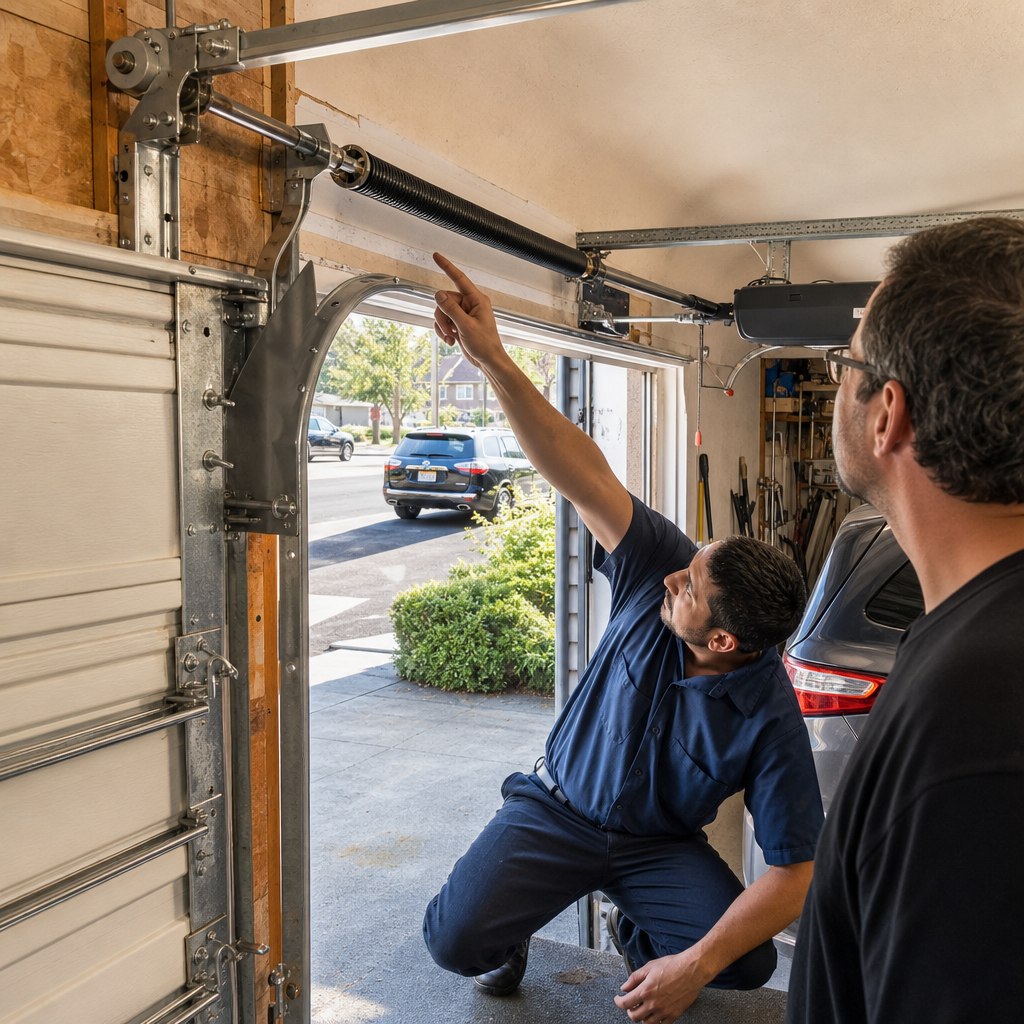
Why Does My Garage Door Reverse in Yonkers, NY?
If your garage door starts to close then immediately reverses back up, the most common cause is the opener’s safety system detecting what it thinks is an obstruction — but the real trigger is often a down-limit or close-force setting that’s out of sync with your actual floor position, not a true blockage. In Yonkers, where winter freeze-thaw cycles heave concrete aprons by fractions of an inch, we see this exact failure mode spike every February and March. Call Bluepeak Garage Door Repair Yonkers at (833) 892-8769 if you’d rather skip the diagnostics and get it fixed today.
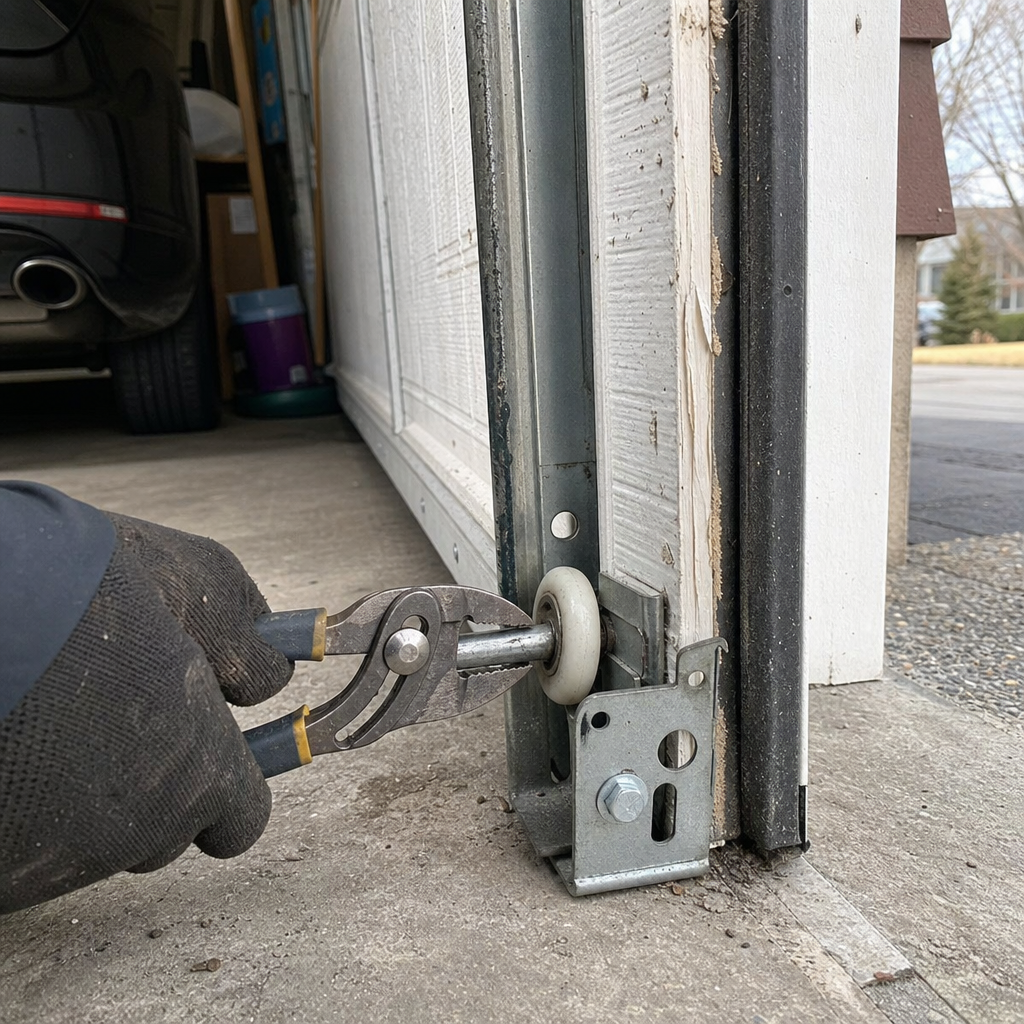
The Yonkers Winter Pattern: When Your Floor Becomes the “Obstruction”
Last Tuesday we got a call from a homeowner in Park Hill. Her door had worked perfectly since Thanksgiving. Then, mid-February, it started reversing three feet from the ground — every single time. She’d cleaned the sensors, replaced the batteries in her remote, even swept the tracks. Nothing helped.
When Jeffrey Morgan arrived, he didn’t touch the sensors. He walked to the opener rail, checked the down-limit switch on her LiftMaster chain drive, and found it set for a floor position that no longer existed. Her concrete apron had heaved upward nearly half an inch since January. The door was making contact with the high spot before the opener expected it to, triggering the force-reversal safety — a scenario where Garage Door Off Track Repair in Yonkers, NY expertise often helps diagnose the true cause. Ten minutes of limit adjustment, problem solved.
This is the pattern we see across Yonkers every late winter, and it’s virtually absent from generic troubleshooting guides written for flat, warm-climate markets. Here’s why it happens:
- Freeze-thaw mechanics: Water trapped in the concrete substrate freezes, expands, and lifts the apron. Yonkers’s Hudson River Valley location puts us in a brutal oscillation band around 32°F — temperatures cross that threshold repeatedly rather than staying deeply cold, which is actually harder on concrete than sustained freezing.
- The limit-setting mismatch: Your opener “learned” your floor position in fall, when the apron was at its lowest. Come February, the door now meets resistance at a higher point. The opener interprets this as something blocking the path — a child, a pet, a bike — and reverses by design.
- Sloped-apron amplification: In hillside neighborhoods like Park Hill and Nodine Hill, where Jeffrey grew up and still lives, garage aprons already slope toward the door. Even minor heave creates asymmetric contact: one corner of the bottom seal touches first, the opener senses uneven resistance, and reversal triggers even though the other corner hasn’t touched down yet.
We call this the “sensor red herring” — homeowners and even some technicians spend hours on photo-eye alignment when the real issue is mechanical contact between door and floor. If I can’t explain what’s wrong in plain English, I haven’t figured it out yet. That’s why Jeffrey asks two questions before scheduling these calls: did it start in February or March, and do you have a sloped driveway? When both answers are yes, he already knows what he’s adjusting.
How to Diagnose a Reversing Garage Door: The Right Sequence
Most DIY guides get the order wrong. They lead with sensors because sensors are easy to explain. But in Yonkers, following the wrong sequence wastes your Saturday and doesn’t fix the door. Here’s the diagnostic order Jeffrey uses on every reversal call:
- Check sensor alignment and LED status. Both photo-eye units should show solid LEDs — typically amber on the sending eye, green on the receiving eye. If either blinks, realign them. But if both LEDs are steady and the door still reverses, move on immediately. Don’t get stuck here.
- Check the down-limit adjustment on the opener. On a Chamberlain or LiftMaster, this is usually a white plastic screw on the side of the motor housing, marked with a down-arrow. On Genie screw-drive units, it’s a limit switch behind the light lens. The door should stop closing exactly when the bottom seal meets the floor, not when it’s compressed into it.
- Physically inspect the apron for heave or crack displacement. Look for new cracks, raised edges, or a visible hump near where the door meets the floor. In Yonkers’s older housing stock — those 1910s–1940s brick garages with single-car masonry openings — aprons are often original concrete, now 80+ years old, and more susceptible to freeze-thaw movement than newer pours.
- Test the close-force sensitivity setting. This controls how much resistance triggers reversal. In winter, when rollers and hinges are stiffer from cold, normal friction can trip an overly sensitive setting. Increase force gradually — but never beyond what’s needed for reliable operation, or you compromise safety.
Skip step three, and you’ll be chasing sensor ghosts while your floor continues to heave. We’ve had Yonkers homeowners replace perfectly good opener circuit boards before discovering a quarter-inch apron rise was the entire problem.
When the Problem Isn’t Winter: Other Reversal Causes We See in Yonkers
Not every reversal is seasonal. Here are the other failure modes Jeffrey diagnoses across his 20 years in the trade, with what they typically cost to resolve:
| Problem | What It Looks Like | Typical Repair Cost in Yonkers |
|---|---|---|
| Worn or broken torsion spring | Door reverses under its own weight, often with visible gap in spring coil | $180–$340 |
| Frayed or snapped cable | Door closes unevenly, one side drops faster, then reverses | $130–$250 |
| Opener drive gear stripped | Motor runs but door doesn’t move, or moves erratically before reversing | $120–$320 |
| Track misalignment or damage | Door binds at a specific point, rollers pop out, reversal happens mid-travel | $120–$240 |
| Roller seizure or breakage | Grinding noise, jerky movement, door stalls and reverses | $110–$220 |
| Faulty circuit board or logic | Intermittent reversal, works fine some days, fails others | $120–$320 |
The safety caveat: torsion springs store massive mechanical energy and can cause serious injury or death if mishandled. We never recommend DIY spring or cable work — the risk isn’t worth the savings. Jeffrey has seen experienced homeowners end up in the ER from a slipped winding bar. If your reversal is accompanied by a loud bang from the spring assembly, stay clear of the door and call our Emergency Garage Door Repair in Yonkers, NY team.
Why Generic Troubleshooting Fails Yonkers Homeowners
Search “why does my garage door reverse” and you’ll find the same checklist everywhere: check sensors, check sensors again, maybe mention lubrication. None of these pages account for the specific conditions we live with.
Yonkers rises sharply from the Hudson River waterfront to 300+ feet within a mile or two inland. That topography means a disproportionate share of garages are built into hillsides with sloped aprons — conditions that simply don’t exist in the flat Midwestern suburbs where most garage door content is written. The persistent freeze-thaw cycling, combined with river-proximity humidity that accelerates rust on springs and cables, creates a local repair profile that national guides miss entirely.
Then there’s the housing stock. Yonkers’s dense belts of 1910s–1940s attached homes contain garage openings originally sized for era vehicles at 7–7½ feet wide, well below today’s 9-foot standard. Replacement jobs almost always require custom panel orders or structural header modification. When a door in one of these narrow masonry structures starts reversing, the constrained headroom and non-standard track geometry add complexity that flat-rate national pricing doesn’t capture.
That’s why nearly 900 homeowners have reviewed our work — they recognize when someone actually understands their specific building, not just their opener model. Whatever brand is on your door, we know it: LiftMaster, Chamberlain, Genie, Raynor, and the rest. But more importantly, we know Yonkers’s garages.
What Professional Adjustment Actually Involves
When Jeffrey arrives at a reversal call, the process is methodical. He’ll test the door in manual mode first — disconnecting the opener and raising/lowering by hand to feel for binding or uneven weight. This isolates whether the problem is in the door mechanics or the opener logic.
If the door moves freely manually, he moves to the opener. Limit adjustment on modern units is digital (button-press programming on newer LiftMaster and Chamberlain models) or mechanical (screw-based on older Genie and Raynor units). Force settings follow — calibrated with a scale or by feel from two decades of repetition. The final step is testing with a 2×4 laid flat in the door’s path: the door should reverse on contact, confirming safety function isn’t compromised by the adjustment.
For sloped-apron cases in Park Hill or Nodine Hill, he may also recommend a bottom-seal upgrade to a more compressible vinyl or rubber profile, or in persistent cases, apron leveling. These aren’t upsells — they’re solutions to a structural condition that will recur every winter otherwise.
Key Takeaways
- Late-winter reversal in Yonkers is most commonly caused by freeze-thaw apron heave throwing off your opener’s down-limit setting, not sensor failure
- Always inspect your concrete apron for visible rise or cracking before replacing parts
- Sloped driveways in hillside neighborhoods amplify asymmetric contact and premature reversal
- Sensor alignment is worth checking, but don’t get stuck there if LEDs are steady
- Spring and cable work carries genuine injury risk — leave it to trained technicians
FAQs
Most reversal issues in Yonkers cost between $150 and $600 to resolve, depending on whether it’s a simple limit adjustment or requires parts replacement. A straightforward opener limit and force calibration runs toward the lower end of that range, while spring or cable replacement reaches the higher end. Call (833) 892-8769 for an exact quote — estimates are free.
You can safely check sensor alignment and clean debris from tracks, but limit and force adjustments require understanding your specific opener model’s calibration procedure — and torsion spring or cable work should never be DIY due to serious injury risk. If your door started reversing suddenly in late winter, the cause is often apron heave that needs our Garage Door Repair services to assess properly. Call (833) 892-8769 for a no-pressure evaluation.
Cold-weather-only reversal in Yonkers almost always points to freeze-thaw concrete heave changing your floor position relative to the opener’s stored limit, or stiffened rollers and hinges increasing friction enough to trigger an overly sensitive force setting. The Hudson River Valley’s repeated temperature oscillation around 32°F makes this far more common here than in areas with sustained deep cold. When your door won’t open at 7 a.m., that’s exactly when we’re built to help — call (833) 892-8769.
For reversal issues caused by limit or force misalignment, repair is almost always cheaper — typically $120–$320 versus $250–$550 for a new opener installation. However, if your opener is more than 15 years old and showing other symptoms (intermittent operation, noisy motor, obsolete safety features), replacement may be more economical long-term. Jeffrey will give you an honest assessment of which path makes sense for your specific unit and usage. Call (833) 892-8769 to discuss.
When to Call Bluepeak Garage Door Repair Yonkers
If you’ve checked your sensors and the reversal persists, or if this started suddenly after a cold snap, you’re likely dealing with a limit-setting or floor-contact issue that needs hands-on diagnosis. Two decades of garage doors — not two years and a van — is why we’re rated the Best Garage Door Repair in Yonkers, NY, having seen this exact pattern hundreds of times across Yonkers’s hillside neighborhoods and river-proximity homes.
The owner answers the call and often makes the repair. That’s not a slogan; it’s how Bluepeak operates. Jeffrey Morgan still shows up when the call comes in before 7 a.m., still adjusts the torsion spring himself, and still lives in the neighborhood where he grew up. If you’d rather have it looked at, Bluepeak Garage Door Repair Yonkers offers a no-pressure assessment in Yonkers — call (833) 892-8769.
Written by Jeffrey Morgan, Owner & Lead Technician at Bluepeak Garage Door Repair Yonkers, serving Yonkers, NY.