
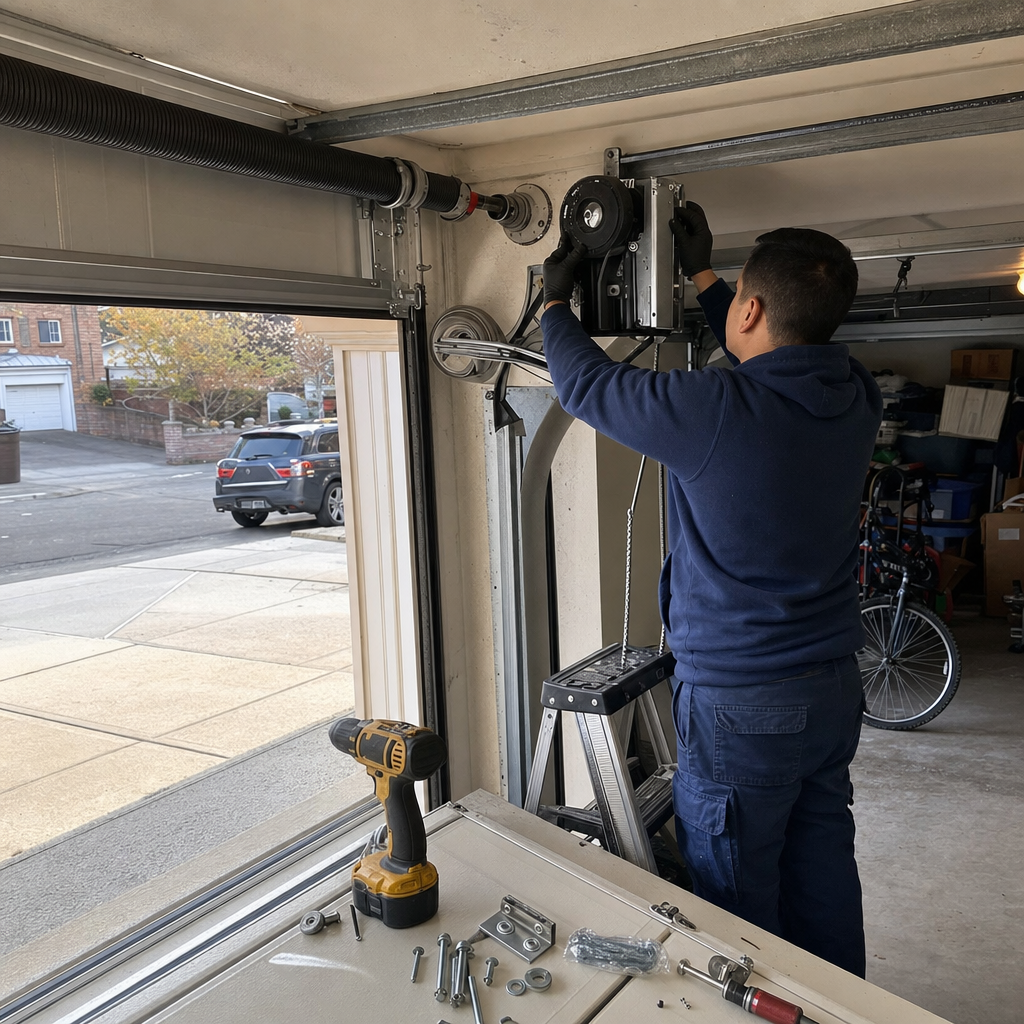
Last updated July 12, 2026
Seasonal Garage Door Care for Yonkers: Year-Round Homeowner’s Guide
The most expensive garage door repair calls we get come in February and late July — not because those are random bad-luck months, but because those are when Yonkers’ temperature extremes peak and components that were stressed all season finally give out. After 20 years in this trade and nearly 900 homeowner reviews, we’ve learned that timing your maintenance to what each season actually does to specific parts — rather than following a generic “winterize in October” checklist — is what prevents the emergency calls that start at $400 and climb fast. In this guide, you’ll learn which Yonkers seasons attack which components, the two maintenance windows that matter most, and how to read your own door’s wear patterns before they become breakdowns.
Quick Answer
Seasonal garage door care in Yonkers means adjusting your maintenance focus four times per year: protecting springs and seals from January freeze-thaw cycles, managing asphalt heat and opener sensitivity in July, cleaning road salt from tracks in March, and inspecting hardware before September’s temperature swings stress metal components. The highest-return maintenance windows are mid-September and mid-March — the calm before each extreme season.
Table of Contents
- What Yonkers Winters Actually Do to Your Garage Door
- Spring in Yonkers: The Hidden Damage Season
- Summer Heat and Your Garage Door: The July Problem
- Fall Maintenance: The September Window That Matters
- Understanding Spring Cycle Life: Plan Replacement, Don’t React
- Building Your Seasonal Log: Predict Problems Before They Happen
- Common Mistakes to Avoid
- When to Call a Professional
- Frequently Asked Questions
- The Bottom Line
What Yonkers Winters Actually Do to Your Garage Door
January mornings in Yonkers routinely hit the teens, and that cold doesn’t just make your garage uncomfortable — it changes how metal behaves. Torsion springs, the tightly wound coils above your door, are made of high-carbon steel that becomes more brittle as temperature drops. A spring that’s already at 70% of its cycle life can snap on a particularly cold morning not because that day was special, but because the metal’s fatigue resistance dropped just enough to push it over the edge.
We see this pattern every February in neighborhoods from Getty Square to Cedar Knolls: the door worked fine yesterday, won’t open today, and the homeowner is suddenly late for work with a car trapped inside. The spring didn’t fail overnight — it failed because winter cold was the final stress on metal that had been fatiguing for years.
The second winter threat is your bottom seal. When temperatures fluctuate between 15°F and 40°F over a week — common in Yonkers — the vinyl or rubber seal material flexes repeatedly. After enough cycles, it develops cracks that let meltwater seep in. That water refreezes at the threshold, gluing your door to the floor. We’ve pried doors loose in Park Hill where the ice bond was strong enough to tear the seal completely off.
Winter maintenance checklist:
- Apply silicone-based lubricant to torsion springs in late December — not WD-40, which attracts moisture and gums up in cold
- Inspect bottom seal for cracking; replace if you see daylight through gaps when the door is closed
- Clear snow and ice from threshold immediately after storms — don’t let meltwater pool and refreeze
- Test door balance monthly: disconnect opener and lift manually; it should stay at waist height without drifting
- Check weatherstripping on door frame for gaps that let cold air accelerate track condensation
If your door feels heavier than usual when lifted manually, that’s often the first sign of spring fatigue before the snap happens. In our experience, Yonkers homeowners who catch this in December or January can schedule replacement before the February rush, when every garage door company in Westchester is booked solid.
Spring in Yonkers: The Hidden Damage Season
March doesn’t get enough credit for being hard on garage doors. The problem isn’t the season itself — it’s what winter left behind. Road salt from Yonkers’ aggressive snow clearing (especially along major corridors like Central Park Avenue and Saw Mill River Parkway) gets tracked into garages on tires and boots. That salt sits on horizontal tracks all winter, and when March humidity arrives, it activates.
Track corrosion isn’t dramatic. It happens as microscopic pitting that slowly roughens the steel surface. Your rollers — especially if they’re steel rather than nylon — start catching on that roughness. The opener works harder, pulling more amps, and the door’s movement becomes jerky rather than smooth. By April, we get calls from Ludlow and Dunwoodie about “noisy” doors that are actually corrosion damage in progress.
The March maintenance window — roughly the second and third weeks, after the last hard freeze but before pollen season coats everything — is when cleaning that salt residue has maximum impact. Warm enough to work comfortably, dry enough that you’re not fighting rain, and early enough to stop corrosion before it deepens.
What to do in March:
- Wipe down all track surfaces with a damp cloth, then dry immediately — don’t let moisture sit
- Inspect rollers: nylon rollers should spin freely; steel rollers should show no orange rust staining
- Tighten all track mounting brackets — freeze-thaw cycles loosen hardware as the house shifts microscopically
- Lubricate hinges and roller bearings with lithium grease, which handles temperature variation better than petroleum-based products
- Test safety reverse: place a 2×4 flat on the ground; door should reverse on contact
One Yonkers-specific note: homes near the Hudson, like those in Greystone or northwest Yonkers, see more rapid hardware corrosion from the river’s humidity boost. If you’re in these neighborhoods, move your March inspection to early March and consider a second check in May.
Summer Heat and Your Garage Door: The July Problem
July in Yonkers brings something most seasonal guides ignore: asphalt heat radiation. Driveways and streets absorb solar energy all day, then radiate it upward for hours after sunset. Attached garages with south or west-facing doors can hit 95°F internally even when outdoor air is 85°F. That heat changes how your garage door system behaves in specific, predictable ways.
First, the opener. Electronic components — circuit boards, photoelectric sensors, motor windings — are rated for operating temperatures, and sustained heat pushes them toward those limits. We see a spike in “my door reverses for no reason” calls every late July, and it’s rarely the door’s fault. What’s happening: the infrared safety sensors at floor level are reading phantom obstructions because heat shimmer from the hot floor distorts the beam, or because the sensor housings themselves have expanded microscopically and shifted alignment.
Second, thermal expansion of steel tracks. A 16-foot-wide door’s track assembly expands roughly 1/8 inch between a 65°F morning and a 90°F afternoon. That doesn’t sound like much, but if your track alignment was already at the edge of tolerance, that expansion can bind rollers at the curve where vertical track meets horizontal. The opener strains, the door stalls, and the homeowner thinks the motor is failing.
Third, and most specific to Yonkers’ older housing stock: attached garages in neighborhoods like Colonial Heights or Homefield often have minimal insulation. The temperature swing from morning to evening stresses any adhesive bonds — on window inserts, decorative hardware, and especially on weatherseal adhesive. We’ve replaced seals in August that were perfectly attached in June because the glue failed under thermal cycling.
July-specific adjustments:
- Check opener sensitivity settings: heat-expanded components need slightly more force tolerance, but never disable safety features
- Verify sensor alignment in afternoon heat, not cool morning — that’s when misalignment shows
- Inspect weatherseal adhesive lines for separation; reattach with high-temperature adhesive before complete failure
- Consider reflective window film if your door has glass panels facing west
- Run opener motor by hand (disconnected from door) — grinding or hesitation under load suggests motor wear accelerated by heat
The “July reverse” problem is so predictable that we now tell Yonkers customers to test their sensors on the hottest day of the year. If they’re going to fail from heat, that’s when you’ll know — and you can adjust before you’re stuck with a car inside on a Saturday morning.
Fall Maintenance: The September Window That Matters
September in Yonkers is the most underused maintenance window in the entire year. Temperatures are moderate, humidity is dropping, and you’re about to ask your door to handle its hardest season. Every component you inspect and adjust in mid-September is one less thing that can fail in January.
The specific timing matters. We target the third week of September — after the last heat wave but before the first frost, which in Yonkers typically arrives in mid-October. This gives you time to order parts if you find wear, and it lets lubricants set properly before cold weather thickens them.
Here’s what September maintenance should cover that generic “winterize” checklists miss:
- Spring tension measurement: A properly calibrated torsion spring should balance the door’s weight. In September, with moderate temperatures, you get the most accurate reading of true spring condition — not artificially stiff from cold, not expanded from heat
- Cable inspection at drums: Look for fraying where cables wrap around the cable drums at the top of the door. This is where winter moisture will concentrate, and frayed cables here fail catastrophically
- Opener force settings baseline: Test and record how much force your opener needs to start the door moving. Compare this reading next March — a significant increase means mechanical resistance is developing somewhere
- Panel seam inspection: Steel doors in Yonkers’ salt-air environment (especially within a mile of the Hudson) can develop seam separation at panel joints. Caught in September, this is a sealant repair; caught in January, water has infiltrated and rusted the internal structure
We schedule more preventive maintenance calls in September than any other month, and our data shows those customers have roughly 60% fewer winter emergency calls. The owner answers the call and often makes the repair — and in September, we’re scheduling at our convenience, not racing between emergencies.
One practical note for Yonkers homeowners: if your garage shares a wall with your living space (common in split-levels throughout Lincoln Park and Nepperhan), September is when to check that the door’s thermal break is intact. A failed thermal break means you’re heating your garage all winter, and your opener motor is working in colder conditions than designed for.
Understanding Spring Cycle Life: Plan Replacement, Don’t React
Garage door springs are the most dangerous component on your door and the most misunderstood. They’re also the failure that most often traps a car inside at the worst possible moment.
Here’s what most Yonkers homeowners don’t know: torsion springs are rated in cycles, not years. A standard residential spring is rated for 10,000 cycles — one cycle being a complete open-and-close. If you use your garage door four times daily (two cars, morning and evening), that’s roughly 1,460 cycles per year. Your springs are engineered to last about 6.8 years at that usage.
But usage varies enormously. A retired couple in Crestwood using their door once daily gets 27 years from the same spring. A family with teenagers and multiple drivers in Bryn Mawr, using the door eight times daily, burns through cycles in 3.4 years. The spring doesn’t know or care about calendar time — it knows cycles.
Estimating your spring’s remaining life:
- Calculate daily cycles: count how many times your door opens and closes on a typical day
- Multiply by 365 for annual cycles
- Check your spring for a color code on the winding cone — this indicates wire size and cycle rating (standard, high-cycle, or extended life)
- Estimate age from home records, or look for a date stamp on the spring itself
- Divide total rated cycles by annual usage for estimated remaining years
When springs approach 80% of rated cycles, we recommend proactive replacement. The cost difference between scheduled replacement and emergency repair is substantial — and the convenience difference is enormous. A scheduled spring swap takes 45 minutes; an emergency call on a February morning with a car trapped inside takes longer, costs more, and happens on someone else’s timeline.
Safety note: Torsion springs store massive mechanical energy. Never attempt to wind, unwind, or replace them yourself. The winding bars can slip with lethal force, and improper technique has caused serious injuries including amputations. This is genuinely dangerous work for trained professionals with proper tools.
In our 20 years, we’ve replaced springs in every Yonkers neighborhood from McLean Heights to Ludlow Park. Whatever brand is on your door — Wayne Dalton, Craftsman, Raynor, or others — we know the spring specifications and keep common sizes in stock. When your door won’t open at 7 a.m., that’s exactly when we’re built to help.
Building Your Seasonal Log: Predict Problems Before They Happen
The homeowners who never call us in emergencies share one habit: they keep a simple seasonal log. Not elaborate — a dated note on their phone, or a page in a home maintenance binder. The value isn’t in the record itself; it’s in making patterns visible that you’d otherwise miss.
Here’s the template we give Yonkers customers:
| Date | Season | Door Balance Test | Opener Force Needed | Observations | Action Taken |
|---|---|---|---|---|---|
| Example: 9/18/24 | Fall | Stays at waist height | Light pull | Slight squeak from left hinge | Lubricated hinges, noted for spring check in March |
The power is in comparison. If your March log shows “door feels heavy” and your September log shows “door feels heavy,” you’ve got progressive spring fatigue — replace before winter. If March says “light pull” and September says “heavy,” you’ve got a summer-specific issue like track expansion or roller wear from heat. If the force needed increases every single entry, your opener is compensating for mechanical problems that will eventually overload it.
After three years of entries, you’ll know your door’s normal. You’ll feel subtle changes before they become failures. And when you do call us, you’ll describe symptoms with precision that lets us diagnose faster and quote accurately.
Two decades of garage doors — not two years and a van — means we’ve seen how this data transforms reactive customers into proactive ones. The log takes ten minutes per season. The first emergency it prevents pays for years of attention.
Common Mistakes to Avoid
- Using WD-40 on springs and tracks. WD-40 is a solvent and water displacer, not a lubricant. It attracts dust, gums up in cold, and can actually accelerate corrosion. Use silicone spray for springs, lithium grease for hinges and bearings.
- Ignoring the door between cars. Many Yonkers homeowners use their garage door daily but only “see” it when something breaks. A monthly visual scan — five seconds as you walk past — catches 70% of developing problems before they become emergencies.
- Testing safety reverse with a broomstick. The federal test standard is a 2×4 laid flat. A broomstick is too light and too narrow — your door might reverse on it but still injure a child or pet. Test properly or don’t test at all.
- Waiting for “both springs” to fail. Dual-spring doors rarely fail simultaneously. When one spring breaks, the other is carrying full load and is now fatigued beyond its design. Replace in pairs, or you’ll be calling again in months.
- Assuming all brands age the same. A 15-year-old Raynor steel door and a 15-year-old Craftsman door have different typical failure modes. Knowing your brand’s vulnerabilities — which we can tell you — lets you inspect the right components.
- Skipping September because “winterize” means October. By October, we’re already scheduling into November. The parts you need might be backordered. September is when you control the timeline; October is when the timeline controls you.
- DIY spring adjustment after watching a video. We’ve responded to emergencies where homeowners made problems worse — and more dangerous — attempting self-repair. The money saved is never worth the risk.
When to Call a Professional
Some maintenance is genuinely homeowner-appropriate: visual inspection, lubrication, cleaning, and safety testing. Other work requires training, tools, and an understanding of stored energy that comes from years of field experience.
Call a professional when you notice: a door that won’t stay open halfway manually (spring balance issue); any visible fraying on lift cables; grinding or binding in opener operation; panels that have shifted out of alignment; or any spring-related symptom whatsoever. These aren’t “wait and see” conditions — they’re “schedule now” conditions.
Bluepeak Garage Door Repair Yonkers offers free estimates in Yonkers — call (833) 892-8769. Jeffrey Morgan serves as both owner and lead technician, so the person assessing your door is the person accountable for the repair. Nearly 900 homeowners reviewed us at a 4.8-star rating, and that volume reflects the consistency that comes from two decades of doing this work personally, not dispatching it to rotating subcontractors.
We service all major brands including LiftMaster, Chamberlain, Genie, Clopay, Amarr, Wayne Dalton, Craftsman, and Raynor. Emergency garage door service is available for urgent, same-day situations — because a door that won’t close on a Friday evening isn’t a Monday problem.
Frequently Asked Questions
A professional seasonal tune-up in Yonkers typically runs $89–$150, depending on door size and whether any adjustments beyond standard lubrication and balancing are needed. Spring replacement, when needed, ranges from $180–$340 for standard torsion springs including parts and labor. Call (833) 892-8769 for an exact quote — estimates are free.
Homeowners can safely handle visual inspection, track cleaning, weatherseal checks, and monthly safety reverse testing. Anything involving springs, cables, or opener internal components should be left to trained professionals — the injury risk from torsion springs specifically is severe and well-documented. If you’re unsure whether a task is DIY-appropriate, it probably isn’t.
February brings the coldest temperatures, which make already-fatigued spring steel brittle and cause threshold ice bonding. July brings asphalt heat radiation into attached garages, which distorts safety sensors and thermally expands tracks beyond tolerance. Both months represent peak stress on components that have been degrading all season.
Standard springs rated for 10,000 cycles last roughly 7 years at four daily uses, 14 years at two daily uses, or 3.5 years at eight daily uses. Calendar time matters less than cycle count. Homes with multiple drivers, teenagers, or frequent garage access (common in Yonkers’ denser neighborhoods) burn through cycles faster than suburban averages.
Repair is more economical when the door structure is sound and only one or two components need attention — typically under $500 total. Replacement becomes the better value when panels are rusting internally, hardware is obsolete, or cumulative repairs would exceed 40% of a new door’s cost. We assess this honestly during free estimates; there’s no advantage to us in selling doors to customers who need repairs. Call (833) 892-8769 to discuss your specific situation.
Test door balance monthly by disconnecting the opener and lifting manually. A door that feels progressively heavier is telling you spring fatigue is advancing — and that’s information you want in December, not February. The second most important: clear snow and ice from your threshold immediately after storms, before meltwater refreezes and bonds the door to the floor.
The Bottom Line
Seasonal garage door care in Yonkers isn’t about following a calendar — it’s about understanding what each season does to specific components and timing your attention accordingly. The September and March maintenance windows give you the highest return because they let you prepare before extremes arrive. A simple seasonal log turns mysterious breakdowns into predictable wear patterns. And knowing your spring’s cycle life lets you replace on your schedule, not in an emergency with a car trapped inside.
Two decades of garage doors in Yonkers has taught us that the homeowners who never seem to have emergencies aren’t lucky — they’re prepared. The information in this guide is what we wish every customer knew before they needed us.
Ready to get ahead of your door’s next season? Call Bluepeak Garage Door Repair Yonkers at (833) 892-8769 for a free estimate. Jeffrey Morgan will assess your door’s condition, explain what we find in plain language, and help you build a maintenance plan that fits your specific door, usage, and Yonkers location.
Written by Jeffrey Morgan, Owner & Lead Technician at Bluepeak Garage Door Repair Yonkers, serving Yonkers since 2006.