
Last updated July 12, 2026
Garage Door Repair Maintenance Checklist for Yonkers Homeowners
In 20 years of garage door work, the same story comes up over and over: a homeowner ignores a grinding noise for six weeks, the bearing goes, the spring overloads, and a $15 fix becomes a $400 job. Bronxville and Yonkers winters accelerate that timeline. Road salt, freeze-thaw cycles, and the vibration from heavy traffic on the Bronx River Parkway and Cross County Parkway create a failure sequence we’ve seen play out hundreds of times. This checklist is built to break that cycle — not with generic advice, but with the specific inspection routine, lubricants, and documentation habits that actually protect doors in this climate.
Quick Answer
A proper garage door maintenance checklist for Yonkers homeowners includes a monthly 90-second visual inspection, quarterly lubrication with silicone-based products (not WD-40), bi-annual hardware tightening, and seasonal checks for salt damage and moisture intrusion. Following this routine can prevent 80% of the common failures we see in Westchester County homes, where temperature swings and urban environmental stressors wear components faster than in suburban or rural settings.
Table of Contents
- The Yonkers Failure Sequence: How Small Problems Become Big Bills
- The 90-Second Monthly Inspection That Catches 80% of Problems
- What to Lubricate (and What Never to Use) in Westchester Winters
- Seasonal Maintenance: Salt, Moisture, and Freeze-Thaw Damage
- Hardware, Springs, and Tracking: The Bi-Annual Deep Check
- Building a Maintenance Log for Warranty Claims and Home Sales
- Common Mistakes to Avoid
- When to Call a Professional
- Frequently Asked Questions
The Yonkers Failure Sequence: How Small Problems Become Big Bills
Most maintenance checklists treat symptoms in isolation. We’ve found it more useful to show homeowners the cascade — the predictable chain of failures that starts with one ignored warning sign.
Here’s the sequence we see most often in Yonkers attached garages, where doors typically cycle 4–6 times daily:
- Week 1–2: Slow response or slight hesitation. The opener strains, but the door still moves. Homeowners adjust — they push the button twice, or help it along manually.
- Week 3–4: Grinding or squeaking develops. Rollers are drying out, or the track has accumulated grit from street-level air. The noise is intermittent, easy to dismiss.
- Week 5–8: The door begins to hang unevenly or seal poorly against the floor. Cable tension shifts. The bottom seal, already stiffened by cold, starts to gap — especially on the side facing the street where salt spray concentrates.
- Week 9–12: Spring fatigue or bearing failure. The opener is now working against increased resistance. In our experience, this is where the $15 roller replacement becomes a $180–$340 spring repair, or worse, a $600+ opener replacement because the motor has overheated from overwork.
In Garage Door Repair in Bronxville and Yonkers, this timeline compresses by 30–40% in winter. The thermal expansion between a 15°F morning and a 45°F afternoon stresses metal components more than steady cold would. And road salt — tracked in on tires, splashed by passing traffic — corrodes bottom hardware faster than almost anywhere else we work in Westchester County.
The checklist below is designed to interrupt this sequence at Stage 1, when intervention costs almost nothing.
The 90-Second Monthly Inspection That Catches 80% of Problems
This isn’t a “look at it sometimes” suggestion. We’ve tracked our call logs: homeowners who do this monthly inspection call us for preventive fixes 80% less often than those who wait for failure.
Do this with the door closed, then again with it open:
- Visual sweep of cables and springs. Look for fraying, rust bloom, or gaps in the coil winding. In Yonkers, we see salt-induced surface rust on springs as early as 18 months after installation — not enough to weaken the spring yet, but a clear signal to schedule a closer look.
- Track alignment check. Stand inside the garage, door closed, and sight down each vertical track. They should be perfectly plumb. Even ¼-inch deviation causes roller wear and opener strain. Street vibration from heavy trucks on Central Park Avenue or the Saw Mill River Parkway can loosen track brackets over time — we’ve resecured dozens in the Getty Square and Ludlow Park areas.
- Bottom seal and weatherstripping. Look for cracks, compression set (the seal stays flattened when the door opens), and salt residue. White crystalline buildup means salt is actively corroding the seal material and the aluminum retainer.
- Photo-eye test. Close the door, then wave a broom handle through the beam. It should reverse immediately. Dirty or misaligned photo-eyes cause more “my door won’t close” emergency calls in Yonkers than any other single issue.
- Balance test (monthly, but critical). Disconnect the opener (pull the red release handle), then lift the door manually to waist height. It should stay there. If it falls or shoots up, spring tension is off — and your opener is compensating, shortening its life.
Time investment: 90 seconds. Potential savings: $200–$900 per avoided failure.
One note on the balance test: garage door springs are under extreme tension and can cause serious injury if handled improperly. This is an observation test, not a repair procedure. If the door doesn’t balance, that’s your signal to call a trained technician — not to adjust springs yourself.
What to Lubricate (and What Never to Use) in Westchester Winters
Here’s where most DIY maintenance goes wrong. The wrong lubricant attracts dirt, gums up in cold, or evaporates in weeks — sometimes making things worse than no lubrication at all.
What we see in Yonkers garages that causes problems:
- WD-40 as a lubricant. It’s a water displacer and light penetrating oil, not a lubricant. It dries to a sticky film that collects road grit. We’ve replaced rollers that were effectively sandpaper from WD-40 + Yonkers street dust.
- Heavy grease on tracks. Garage door tracks should never be lubricated — the rollers need to roll, not slide. Grease on tracks causes the exact opposite.
- Standard household oils in cold weather. They thicken and become viscous below freezing, increasing resistance precisely when the door already struggles.
What actually works for Yonkers climate:
| Component | Product Type | Application Frequency |
|---|---|---|
| Hinges | Silicone-based spray or white lithium grease | Quarterly |
| Roller bearings (steel, not nylon) | Light machine oil or dedicated garage door lube | Quarterly |
| Spring coils | Silicone spray — light coating | Bi-annually (before and after winter) |
| Lock mechanism | Graphite powder or dry Teflon lube | Annually |
| Opener chain/belt | Manufacturer-specified lubricant | Per opener manual (typically annually) |
For Clopay and Amarr doors — common in Yonkers developments built 1995–2015 — the hinge pin design benefits particularly from silicone spray that won’t migrate onto the door panel finish. Wayne Dalton doors with their unique pinch-resistant hinges need the same attention, but applied more precisely to avoid buildup in the hinge cavity.
Apply lubricant in fall, before the first sustained freeze, and again in late March after the worst of the salt season. If you’re not comfortable working around spring hardware, this is a natural time to schedule professional service.
Seasonal Maintenance: Salt, Moisture, and Freeze-Thaw Damage
Yonkers presents a specific environmental profile that generic checklists ignore. Here’s what to address by season:
Fall (October–November): Pre-Winter Prep
- Inspect and replace bottom seal if compressed or cracked. A proper seal prevents the melt-refreeze cycle that ices doors to the floor — common in below-grade and attached garages in neighborhoods like Crestwood and Lawrence Park.
- Lubricate all moving components before cold sets in.
- Check garage floor drain function if present. Standing water from autumn rains becomes standing ice.
- Test battery backup on opener. Power outages spike in Westchester winter storms; a dead backup battery means you’re manually lifting a 150+ pound door.
Winter (December–March): Active Monitoring
- Weekly: clear salt and slush from door threshold. Sodium chloride accelerates corrosion of aluminum retainers and steel hardware.
- After major storms: check for ice damming at the header seal. Forced opening against ice damages the top section and opener rail.
- Listen for opener strain. Cold-stiffened springs require more force; if your Genie or LiftMaster sounds labored, the system is telling you something.
Spring (April–May): Post-Salt Recovery
- Wash bottom 12 inches of door and all hardware with fresh water to dissolve residual salt.
- Inspect for rust bloom on springs, cables, and track brackets.
- Re-lubricate after cleaning — the wash strips protective coatings too.
Summer (June–September): Structural Check
- Inspect door panel for warping or delamination. Humidity in Yonkers basements and attached garages affects wood-composite doors.
- Test auto-reverse sensitivity. Warm weather can affect opener electronics differently than cold.
- Check weatherstripping on sides and top — summer is the easiest time to replace it.
Homes near the Hudson River or in lower-elevation areas like Nepperhan encounter more moisture intrusion. We’ve replaced bottom sections on 8-year-old doors that should have lasted 20, simply because the garage stayed damp year-round and maintenance never addressed it.
Hardware, Springs, and Tracking: The Bi-Annual Deep Check
Twice yearly — we recommend May and October for Yonkers homeowners — go beyond the 90-second scan. This 15-minute routine catches the structural issues that monthly inspection misses.
- Hardware torque check. With the door closed, examine every bolt and screw you can see: track brackets, opener mounting straps, hinge screws, roller brackets. Use a socket wrench to check tightness — don’t overtighten, but confirm nothing has vibrated loose. The constant rumble from Metro-North corridors and major arterials in Yonkers loosens hardware faster than in quieter locations.
- Spring inspection with measurement. Look for coil gaps that weren’t there before (indicates stretch and fatigue), rust penetration beyond surface discoloration, and end-cone integrity. Standard torsion springs are rated for 10,000 cycles — about 7 years at 4 cycles/day. High-cycle springs last longer but still fatigue. If your springs are original to a 2015 installation, they’re in the replacement window now regardless of appearance.
- Cable wear assessment. Fraying anywhere on the cable is automatic replacement — cables fail catastrophically, not gradually. Check where cables wrap around the drum; this is where wear concentrates.
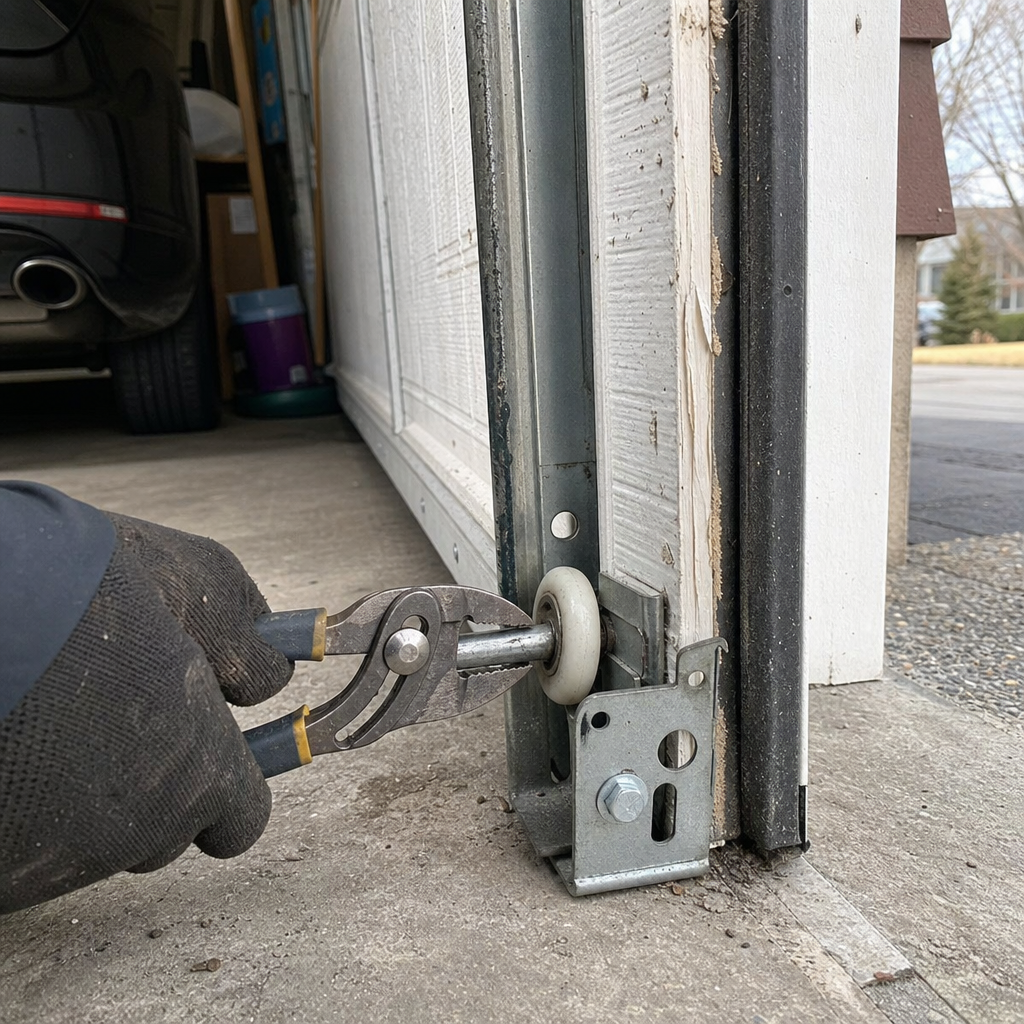
- Roller condition and type inventory. Steel rollers with unsealed bearings wear fastest. Nylon rollers with sealed bearings last longer and run quieter — worth considering on replacement. Count how many rollers you have (typically 10–12 on a standard door) and note any that wobble in the track.
- Track fastener and anchor inspection. The bracket that holds the horizontal track to the ceiling is the most stress-loaded point. Look for pulled or elongated bolt holes, especially in older Yonkers homes with plaster-and-lath or softwood joist ceilings.
- Opener force and limit settings. Test the down-force setting: place a 2×4 flat on the floor centered under the door. The door should reverse on contact. If it doesn’t, the force setting is too high — dangerous and wearing on the system.
After this check, update your maintenance log (see next section) with what you found, what you addressed, and what needs professional attention.
Building a Maintenance Log for Warranty Claims and Home Sales
This is the checklist item almost no one does — and it’s the one that pays off most when you need it.
A documented maintenance history protects you in three specific situations we encounter regularly in Yonkers:
- Warranty claims: Clopay, Amarr, and Wayne Dalton all require proof of “reasonable maintenance” for panel, hardware, and finish warranties. A log with dates and photos satisfies this.
- Home sale negotiations: Westchester County buyers are informed and often request garage door service history. A documented log signals a maintained home and can deflect inspection objections.
- Insurance claims: If a door failure causes damage (vehicle impact, water intrusion from failed seal), documentation of preventive maintenance supports your position.
Minimum viable log format:
| Date | Inspection Type | Findings | Action Taken | Next Action Due |
|---|---|---|---|---|
| Example: 10/15/2024 | Fall deep check | Bottom seal compressed 30%, slight rust on left spring | Replaced seal, scheduled spring inspection | Spring check 11/1/2024; monthly visual 11/15/2024 |
Store photos with timestamps — phone camera metadata works. Photograph springs, cables, bottom seal, and any problem areas. Cloud storage is fine; the key is organization.
For homeowners in Yonkers’ older housing stock — pre-war homes in Park Hill, Victorian-era properties in the Dunwoodie area — this documentation is especially valuable. Original garage structures often have non-standard clearances or modified openings, and maintenance records help any future technician understand what’s been adapted over time.
Common Mistakes to Avoid
- Using WD-40 on anything that moves. In Yonkers garages, this combines with airborne salt and grit to form an abrasive paste. We’ve disassembled rollers that were effectively glued in place by this mixture.
- Ignoring the door because the opener still works. The opener is a compensating machine — it will destroy itself rather than tell you the door is out of balance. A strained opener motor is often the symptom, not the disease.
- Adjusting spring tension or cable drums DIY. These components are under lethal tension. Every year, homeowners are seriously injured attempting this. Observation and professional referral are the correct responses to spring or cable issues.
- Waiting for “spring cleaning” to do annual maintenance. In this climate, the damage happens between November and March. Fall preparation and mid-winter checks matter far more than April attention.
- Using generic replacement parts from hardware stores. Rollers, hinges, and cables are not universal. Wrong-diameter rollers chew tracks; wrong-cable drums create dangerous tension imbalances. Match by brand and model, or call someone who can.
- Neglecting the emergency release. Test monthly that the red handle disengages the opener and that you can lift the door manually. If you can’t, the door is out of balance — a problem that will burn out your opener and strand you in a power outage.
- Assuming a quiet door is a healthy door. Nylon rollers and belt-drive openers run almost silently. Silence doesn’t mean maintenance isn’t needed — it means problems develop without audible warning.
When to Call a Professional
Some maintenance is homeowner-appropriate; some requires training and equipment. Call a professional when you encounter:
- Any spring or cable wear, damage, or imbalance indication
- Door that won’t stay at mid-height in manual operation
- Track misalignment beyond ¼ inch, or any track damage
- Opener strain, overheating smell, or repeated thermal shutdown
- Panel damage, especially on insulated doors where core integrity matters
- Any situation where you’re unsure of safe procedure
Bluepeak Garage Door Repair Yonkers offers free estimates in Yonkers — call (833) 892-8769. Jeffrey Morgan, our owner and lead technician, still handles the majority of service calls personally. When you describe what you’ve found, you’re talking to the person who will likely be making the repair, not a dispatcher reading from a script.
We service all major brands including Garage Door Installation in Bronxville and Yonkers homes regularly see: Genie, Clopay, Amarr, Wayne Dalton, LiftMaster, Chamberlain, Craftsman, and Raynor. Whatever brand is on your door, we know it — and we’ve maintained it through Westchester winters before.
Frequently Asked Questions
Monthly 90-second visual inspections, quarterly lubrication, and bi-annual deep hardware checks are the minimum for Yonkers’ climate. The freeze-thaw cycles, road salt exposure, and urban vibration here wear components faster than in less demanding environments. Call (833) 892-8769 if you’re unsure where your door stands — estimates are free.
Failed bottom seals and salt-corroded hardware leading to opener strain. The combination of road salt, slush, and freeze-thaw in attached urban garages destroys seals in 2–3 years and accelerates rust on springs and cables. Caught early, seal replacement is under $100; ignored, it cascades into track damage and opener failure.
No — WD-40 is not a lubricant for this application. It’s a water displacer that leaves a sticky residue, which in Yonkers combines with airborne salt and grit to form an abrasive paste. Use silicone-based spray or white lithium grease on hinges, and light machine oil on roller bearings. For opener chains and belts, follow the manufacturer’s specification.
Signs include: door that won’t stay at mid-height when disconnected from the opener, visible coil gaps or stretch in the spring, rust penetration beyond surface discoloration, and opener that sounds increasingly strained. Garage door springs are under extreme tension and can cause serious injury — this is observation-only for homeowners; adjustment or replacement requires a trained professional.
Manufacturer warranties for brands like Clopay, Amarr, and Wayne Dalton typically require proof of “reasonable maintenance” for coverage. Home insurance doesn’t usually mandate maintenance, but documented upkeep strengthens your position if a door failure causes damage you need to claim. A simple dated log with photos satisfies most warranty requirements.
We provide scheduled preventive service and will set recurring appointments aligned with the seasonal checklist above. When your door needs attention, the owner answers the call and often makes the repair — direct accountability that larger companies can’t match. For maintenance scheduling or a free condition assessment, call (833) 892-8769.
The Bottom Line
Garage door maintenance in Yonkers isn’t about perfection — it’s about interrupting predictable failure sequences before they cascade. The 90-second monthly inspection, correct lubricants for the climate, seasonal salt management, and a simple maintenance log will prevent most of the expensive repairs we make. The homeowners who never call us for emergencies are the ones who noticed the grinding, checked the balance, and acted while the fix was still minor. Two decades of garage doors — not two years and a van — has taught us that prevention is the only real bargain in this trade.
Written by Jeffrey Morgan, Owner & Lead Technician at Bluepeak Garage Door Repair Yonkers, serving Yonkers since 2006.